E-mail: John@xhgraphite.com
WhatsApp: +86-18663987730
E-mail: John@xhgraphite.com
WhatsApp: +86-18663987730

News
A fire-stopping system earns its E or EI class as an assembly, not as a material. Expandable graphite is one component inside that assembly: when the seal is heated, the graphite expands and pushes a char mass against the gap, helping the system hold its integrity (E) and insulation (I) for the rated period. That means the material data sheet cannot be read directly as a performance class — but it does tell you which graphite grade can realistically support which target. This guide sets out that mapping, the test route behind it, and the fields a buyer should put in the purchase specification so the manufacturer's declaration has something to stand on.
It deliberately does not repeat the general selection guide (onset temperature, expansion ratio, mesh, fixed carbon). If you need that baseline, start with Expandable Graphite for Intumescent Fire Protection. This article starts one step downstream, at the point where a specification has to satisfy a test standard and a declaration.
Fire resistance classes describe how a construction element behaves under a defined thermal load. The test heats a specimen that includes the separating element (wall or floor), the service penetrating it, and the seal in between. Integrity is judged by whether flames or hot gases pass through; insulation by whether the unexposed face stays below the temperature limits. Both are properties of the whole specimen and its installation detail.
A graphite grade that expands beautifully in a free-expansion lab test can still fail inside a thin annulus, because the char has nowhere to build and gets pushed aside by differential movement. Conversely, a moderate-expansion grade with good cohesion can carry a seal to 120 minutes when the gap geometry and the substrate are favourable. The class follows the system; the grade follows the system's mechanics.
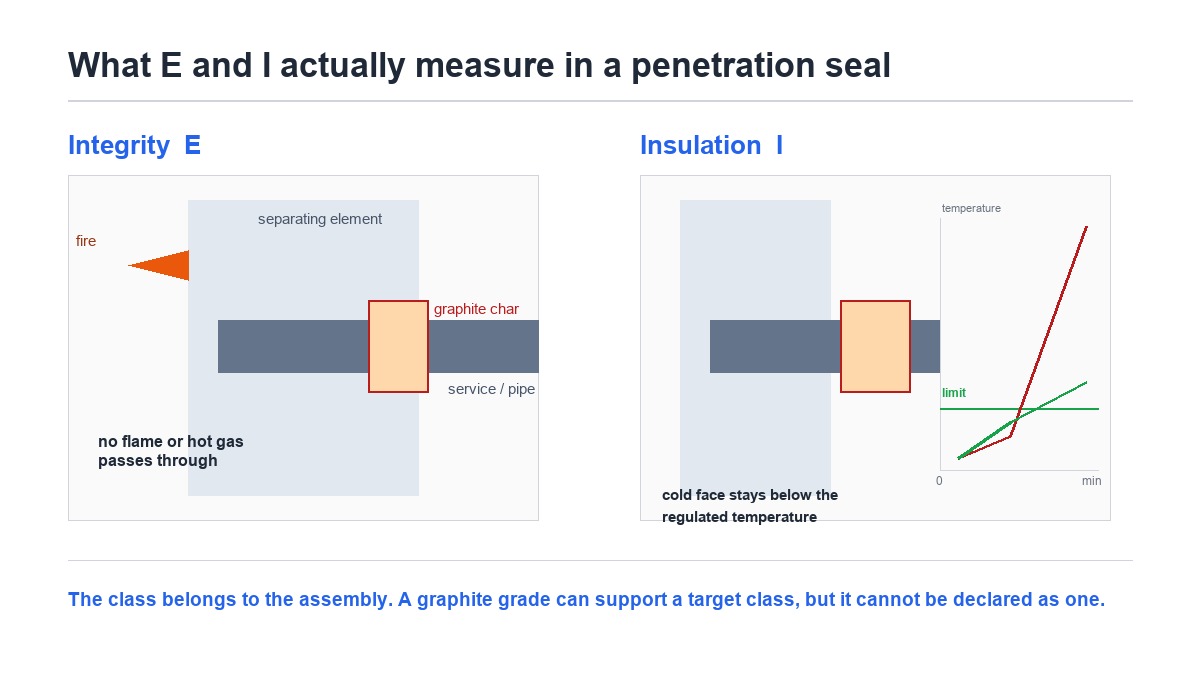
Figure 1 — Integrity (E) stops flame and hot gas; insulation (I) keeps the unexposed face below the temperature limits. Both are judged on the whole assembly, not on the material.
Three families of fire-stopping products use expandable graphite as the intumescent engine. Each puts the material under different mechanical conditions, so the grade requirements differ.
| System | Test standard | Typical classes | What the grade has to deliver |
|---|---|---|---|
| Penetration seals (cable, pipe, mixed) | EN 1366-3 | E / EI 15–240 | Expansion volume against a confined annulus; cohesion under compression; controlled onset below the service's failure point |
| Linear joint seals | EN 1366-4 | E / EI 15–240 | Expansion across a moving gap; flexibility of the char; resistance to being pulled apart by joint movement |
| Intumescent seals in doors, boards and timber elements | EN 1634-1, EN 1365 series | E / EI, plus smoke leakage classes | Fast onset, low residue, dimensional stability after cycling |
The class ranges listed are those set out in the harmonised classification system: E and EI are expressed in minutes, and for penetration seals and linear joint seals the published steps run 15, 20, 30, 45, 60, 90, 120, 180 and 240. The classes themselves were carried over unchanged into the new legal framework — see the news piece on how EU fire classes are declared from 2026 for the regulatory side.
Four material parameters do most of the work. Read each one against the system, not against the number on the certificate.
Fire resistance testing follows the standard temperature-time curve, which passes 500 °C within the first few minutes. A grade with a 180–220 °C onset therefore reacts early and keeps expanding through the growth phase of the fire; a 250–280 °C grade reacts later and is a better fit where the compound must survive high processing temperatures. For fire-stopping, early response matters more than peak expansion, because the char has to close the gap before the service deforms. If your process runs above 190 °C, that constraint wins and you should look at the higher-onset band instead.
The useful question is not "how many times does it expand" but "is there enough material to fill the void". A 30 mm annular gap around a 100 mm pipe needs a calculable char volume; a 10 mm joint needs far less. Over-specifying expansion is a common waste — and in thin sections it can worsen mechanical weakness, because highly expanded char is friable. Under-specifying leaves a void that hot gas will find.
Coarse flakes (around 50–80 mesh, roughly 180–300 µm) build a thicker, more voluminous char and suit open joint profiles and thick seals. Fine grades disperse better and fill small annuli and complex mixed penetrations, at the cost of total volume. In practice, mixed penetration seals often use a blend: coarse for volume, fine for coverage at the perimeter.
Fixed carbon above 90 % is the common commercial floor, with 93 % and higher available. What matters for a seal is the residue: a char with low ash and consistent structure holds together under hose-stream and differential-movement conditions. Moisture is the quieter risk — it drives gas generation during compounding and can leave porosity that undermines the intumescent response on the day it is needed. Ask for both, and for the test method behind the moisture figure.
A fire-stopping product reaches the EU market through a chain that a graphite supplier sits at the bottom of, and it is worth knowing the whole route because it determines what evidence your customer will ask you for.
Step 1 — material data. The graphite grade's data sheet, plus the batch records that show it stayed inside its declared window. This is what you supply.
Step 2 — system test. The seal manufacturer tests the complete system to EN 1366-3 or EN 1366-4, with the classification data then processed under EN 13501-2. The result belongs to the tested configuration, including the substrate type and the service diameter range.
Step 3 — declaration. From 8 January 2026 the main body of Regulation (EU) 2024/3110 applies: declaration of performance and conformity, European assessment documents and the obligations of economic operators. Fire resistance classes for declaration under that Regulation are now set by Commission Delegated Regulation (EU) 2026/557, in force since 23 June 2026, which reproduces the existing class system so that declared values stay comparable.
Step 4 — market surveillance. The new regulation's surveillance chapter replaced the CPR 2011 rules on the same date, and national penalties had to be notified by 8 December 2026, with the penalty provisions applying from 8 January 2027. In practice, a declaration that cannot be traced back to a test report is the one that gets challenged.
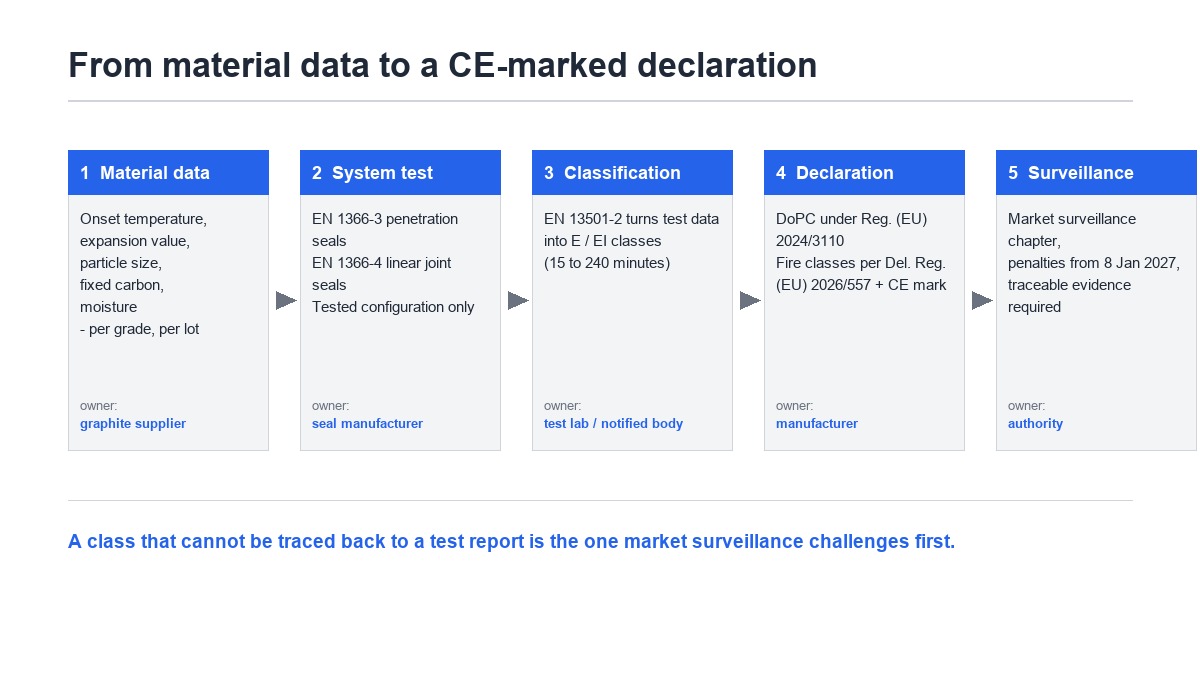
Figure 2 — The evidence chain behind a declared fire class, and where each link sits in the supply chain.
If the graphite you buy feeds a declared fire-stopping product, the purchase specification should carry more than a grade name. Six fields do most of the risk reduction:
(1) Onset temperature with method. State the value and the measurement route (TG-DTA, DSC, or a defined muffle-furnace procedure), plus the allowed tolerance.
(2) Expansion value with conditions. Expansion ratio or specific expansion volume means nothing without the heating rate, hold temperature and whether the sample was free or confined.
(3) Particle size distribution, not a single mesh number. Ask for the sieve distribution or a laser result, and set an upper limit on oversize.
(4) Fixed carbon and ash. Minimum carbon, maximum ash, and the standard used.
(5) Moisture ceiling. A maximum, with the drying method specified, because the same percentage measured two ways can differ materially.
(6) Lot traceability and change notification. A commitment that any process change at the graphite plant is notified before shipment, because a silent change invalidates the customer's test evidence.
A template for the clauses is in how to write a graphite purchase specification, and the reading of the accompanying test report is covered in reading a natural flake graphite COA.
No — and a supplier who offers one should be treated carefully. The class belongs to the tested system, installed as tested. What a graphite supplier can guarantee is that the grade stays within its declared window, batch after batch, so the manufacturer's test evidence keeps its validity.
No. Expansion has to be constrained by the gap and held in place. Very high expansion in a thin annulus produces friable char that erodes under the furnace draught; a moderate, cohesive char often performs better over 90 to 120 minutes.
Usually a blend rather than a single cut, because mixed penetrations combine small cable annuli with larger pipe voids. Coarse material supplies volume in the wide spaces; fine material seals the perimeter and the cable bundles.
No. Delegated Regulation (EU) 2026/557 reproduces the class structure already in use — R, E, I, W, M and C expressed in minutes — but gives it a legal basis under Regulation (EU) 2024/3110. What changes is the declaration and surveillance machinery around it, not the classification ladder.
We supply expandable graphite made from natural flake graphite, with onset temperature, expansion volume, particle size distribution and fixed carbon stated per grade on the data sheet. If you are building a fire-stopping system and need to match a grade to a target class, send us the gap geometry, the substrate, the service type and the test standard you will follow — we will narrow the grade range before you commit to a test programme. Other applications are listed under application fields.
Sources: EN 1366-3 (2021, amendment A1 2024), Fire resistance tests for service installations, Part 3: Penetration seals; EN 1366-4 (2021), Part 4: Linear joint seals; EN 13501-2 (2023), Fire classification of construction products and building elements, Part 2 (all CEN). Class steps for penetration seals and linear joint seals as published in the harmonised classification system. Regulatory dates: Regulation (EU) 2024/3110 (OJ L 2024/3110, 18.12.2024), in force 7 January 2025, main application 8 January 2026; Commission Delegated Regulation (EU) 2026/557 (OJ L 2026/557, 3.6.2026), in force 23 June 2026. Material values quoted are supplier-typical, vary by grade and are not a harmonised standard.
Online Message
Leading the Graphite Industry with Innovation and Expertise.
Ma GeZhuang Graphite Mine, Pingdu, QingDao, China
Copyright © 2026 QingDao XingHe Graphite Co.,Ltd. All Rights Reserved.