E-mail: John@xhgraphite.com
WhatsApp: +86-18663987730
E-mail: John@xhgraphite.com
WhatsApp: +86-18663987730

News
Fire resistance classes in the EU now have a legal basis under the new construction products framework. Commission Delegated Regulation (EU) 2026/557, adopted on 16 March 2026 and published in the Official Journal on 3 June 2026, entered into force on 23 June 2026. It sets the classes of performance for the essential characteristic "resistance to fire" that manufacturers must use when declaring under Regulation (EU) 2024/3110 — the replacement for the CPR 2011, whose main provisions started applying on 8 January 2026.
Two things are worth separating. The classification ladder itself has not changed: R, E, I, W, M and C, expressed in minutes, at the same steps as before. What changed is the machinery around the declaration — who declares what, on what basis, and how the market is policed. For suppliers of fire protection materials, including mineral-based intumescent systems, that shift is more consequential than the classes themselves.
| Date | What applies | Who it lands on |
|---|---|---|
| 7 January 2025 | Regulation (EU) 2024/3110 enters into force (partial application) | All economic operators |
| 8 January 2026 | Main application: declaration of performance and conformity, European assessment documents, obligations of economic operators, new market surveillance chapter; global warming potential declaration becomes mandatory for products in scope | Manufacturers, importers, distributors |
| 23 June 2026 | Delegated Regulation (EU) 2026/557 in force: resistance-to-fire classes usable for declaration under the new regulation | Manufacturers declaring fire performance |
| 8 December 2026 | Member States must notify penalties | National authorities |
| 8 January 2027 | Penalty provisions apply | Non-compliant operators |
| 9 January 2030 / 2032 | All core environmental indicators / all life-cycle environmental indicators become mandatory | Manufacturers |
| 2039 | CPR 2011 formally repealed | End of the coexistence period |
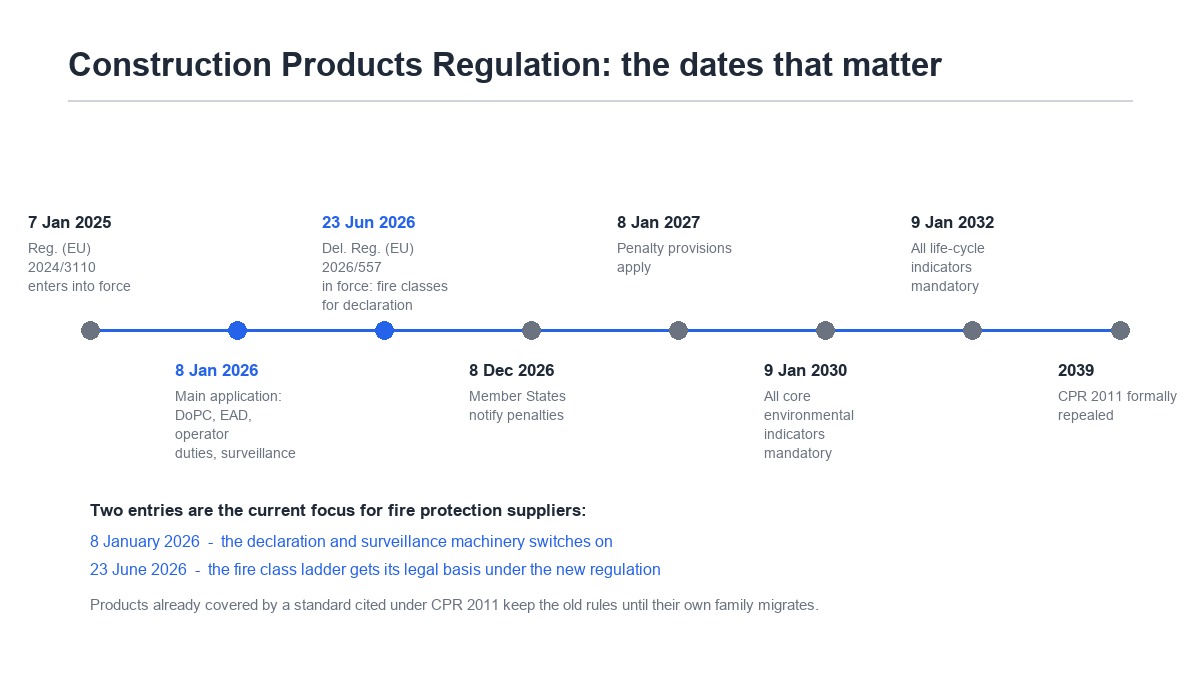
Figure 3 — Regulatory timeline: main application on 8 January 2026, fire-class delegated regulation in force on 23 June 2026, penalties from 8 January 2027.
The two regulations coexist for well over a decade. A product family moves to the new framework only when a harmonised technical specification covering it is cited in the Official Journal under Regulation (EU) 2024/3110. Until then the 2011 rules continue to govern that family — and once a new standard is cited, the old citation is withdrawn after a transition of at least one year.
This is the detail most supplier notices miss. Nothing changed on 8 January 2026 for a product family still covered by a standard cited under the old regulation. The date that matters for a specific product is the citation date of its own harmonised standard, not the general application date of the regulation.
Performance claims need a declaration behind them. The class is now declared in a declaration of performance and conformity, tied to the harmonised specification and the assessed characteristics. A data sheet claiming "EI 120" without a route back to a system test to EN 1366-3, EN 1366-4 or the relevant element standard is exposed in a way it was not before.
Environmental data arrives alongside fire data. Global warming potential became a mandatory declaration for products in scope from 8 January 2026, with the remaining core indicators in 2030 and life-cycle indicators in 2032. A fire-stopping system will increasingly be compared on both axes at once — fire performance and embodied carbon — in tender documents.
Surveillance gets teeth. With penalties applying from 8 January 2027 and a dedicated surveillance chapter in force, the chain of evidence from raw material to finished system becomes an audit target. That reaches back to material suppliers: batch records, declared tolerances and change notification are now part of someone else's compliance file.
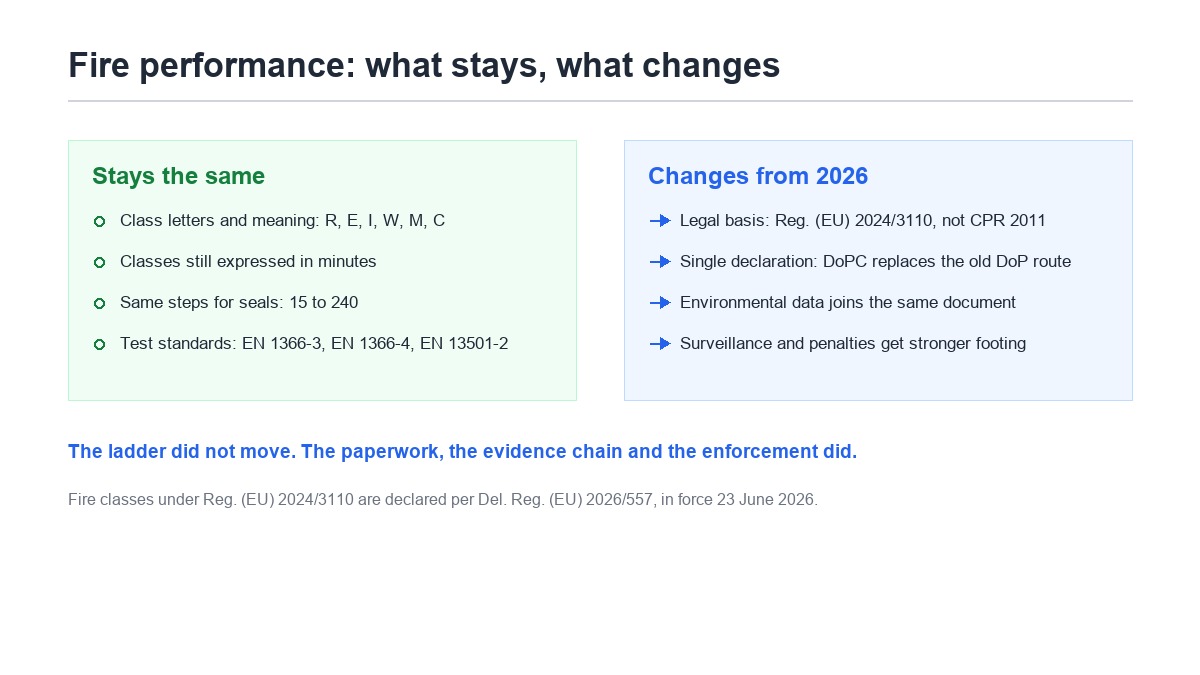
Figure 4 — The classification ladder itself is unchanged. What changed is the declaration, the evidence chain and the enforcement behind it.
Expandable graphite is not regulated by this framework as a product in its own right — it is a component that a seal or board manufacturer declares as part of a system. But the direction of travel is consistent with what has already happened on the extinguishing-foam side: performance has to be evidenced, not asserted, and the evidence has to survive scrutiny years after the sale.
For a formulator choosing between a halogenated chemistry and a mineral intumescent route, the declaration burden now sits on the same footing for both. That removes a historic asymmetry: the halogen route did not have to explain itself as carefully. On the technical side, the question of how a mineral grade maps to a declared class is covered in our guide on mapping graphite data to E and EI classes.
Three practical questions, whether you buy the graphite or the finished seal:
Which standard governs this product family today? If it is still cited under the 2011 regulation, the migration date is not yet fixed for you; if it has moved, the declaration format has changed and your documentation has to match.
Does the declared class trace to a test report? Ask for the report reference and the tested configuration, including substrate and service range. Classes are configuration-specific by design.
Is the environmental declaration on the same document? From 2026 it increasingly is, and a supplier who cannot produce it will lose tenders before the technical discussion starts.
Our expandable graphite grades are supplied with onset temperature, expansion volume, particle size distribution, fixed carbon and moisture stated per grade, plus lot records — the material-side inputs a system manufacturer needs to keep a declaration standing. Application coverage is on the application fields page, and specification wording is covered in how to write a graphite purchase specification.
Sources: Regulation (EU) 2024/3110 of 27 November 2024 (OJ L 2024/3110, 18.12.2024; CELEX 32024R3110) — entry into force 7 January 2025, main application 8 January 2026; Commission Delegated Regulation (EU) 2026/557 of 16 March 2026 (OJ L 2026/557, 3.6.2026; CELEX 32026R0557), Article 2: entry into force on the twentieth day after publication, i.e. 23 June 2026; European Commission, DG Internal Market — "Construction Products Regulation 2024 revision" (timeline and coexistence principle); Access2Markets, construction products technical specifications page, last revised 1 September 2026. Event dates above are as stated in the legal texts; this article was published on 14 November 2026.
Online Message
Leading the Graphite Industry with Innovation and Expertise.
Ma GeZhuang Graphite Mine, Pingdu, QingDao, China
Copyright © 2026 QingDao XingHe Graphite Co.,Ltd. All Rights Reserved.